006 Featured Specimen
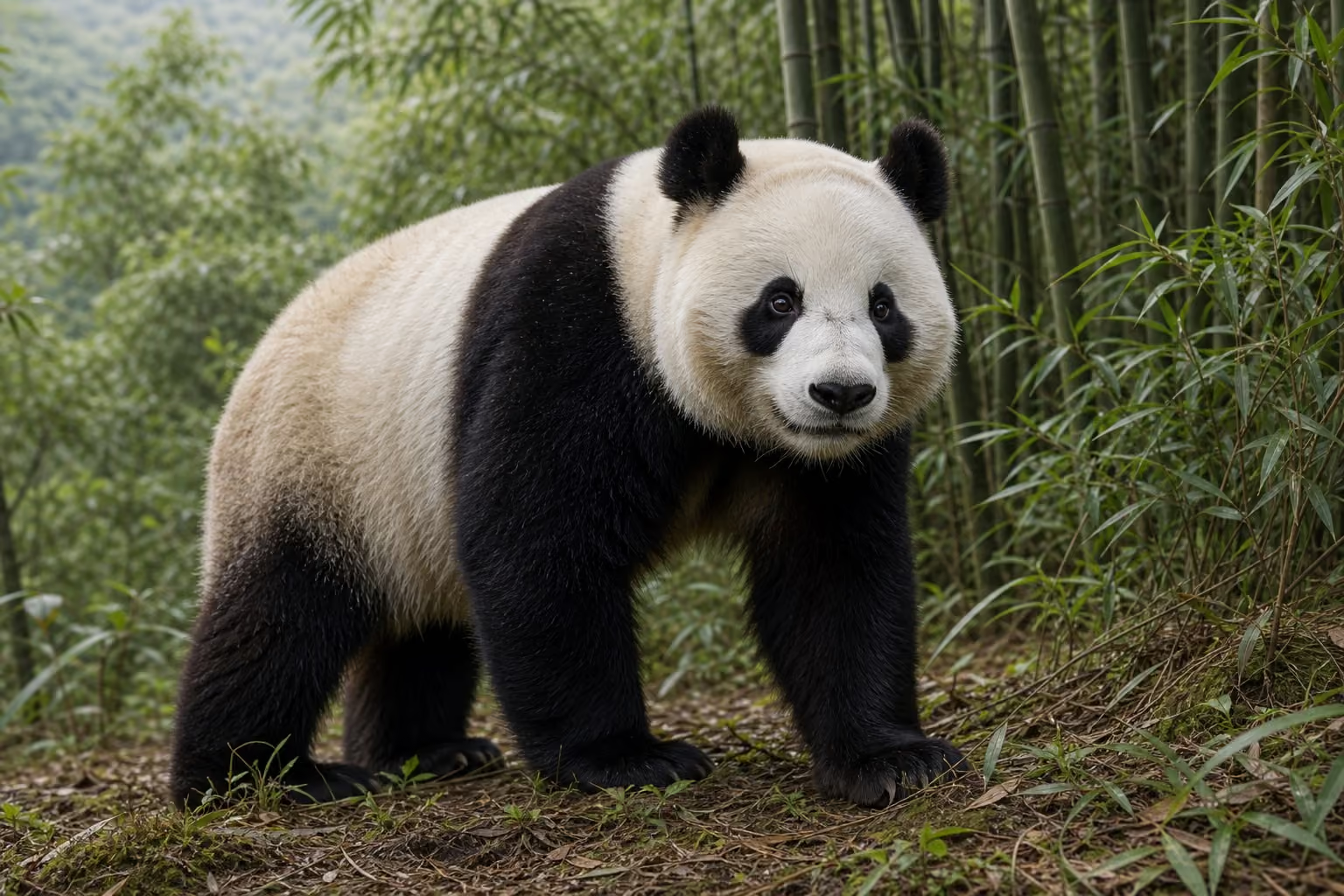
Giant panda

Details

Giant panda

Ailuropoda melanoleuca

Size
1.2–1.9 m · 70–125 kg
Diet
Herbivore
Activity
Cathemeral
Sociality
Solitary
Lifespan
15–20 years (wild)

A black-and-white member of the bear family that feeds almost entirely on bamboo, gripping the stems with a famous "sixth digit"—an enlarged wrist bone that works like a thumb. It survives in the mountain bamboo forests of central China and is one of the world's most beloved rare animals.
Range

Habitat range map
Native range Occasional / Transient

Map: Ecoregions 2017 © RESOLVE (CC BY 4.0) · Natural Earth (PD)

Details

Habitat

Found in the mountains of Sichuan, Shaanxi, and Gansu in central China, it favours cool old-growth bamboo forest at roughly 1,500–3,000 m. Once ranging widely across East and Southeast Asia, its distribution is now confined to a small western remnant.

Appearance

A sturdy bear measuring 120–190 cm and weighing 70–125 kg, with a striking coat that is white except for black eye patches, ears, legs, and shoulders. A modified sesamoid bone forms a pseudo-thumb, letting it grasp and strip bamboo with great dexterity.

Behavior

It lives alone rather than in groups or family units and does not hibernate, ranging only short distances each day. Even outside the breeding season it communicates frequently with neighbouring pandas through calls and scent-marking.

Feeding

About 99% of its herbivorous diet is bamboo leaves, stems, and shoots. Because it digests this poorly, it eats 9–14 kg or more daily and spends roughly half its day—about 14 hours—feeding, with only rare meals of small animals or fruit.

Reproduction

Breeding happens once a year over just a few spring days. After a 95–160 day gestation, females bear one or two young in a hollow tree or cave; newborns weigh only 85–140 g, among the smallest of any placental mammal. Mothers nurse for eight to nine months and cubs stay with them for well over a year.

Notes

Habitat loss and fragmentation, plus famine when bamboo flowers en masse, have long threatened it, but reserve networks and breeding programmes have helped wild numbers recover. A national treasure of China, the panda is a global symbol of wildlife conservation.