059 Featured Specimen
Secretarybird

Details

Secretarybird

Sagittarius serpentarius

Size
Height 1.2–1.5 m · 2.3–4.5 kg
Diet
Carnivore
Activity
Diurnal
Sociality
Pair
Lifespan
Several years to decades

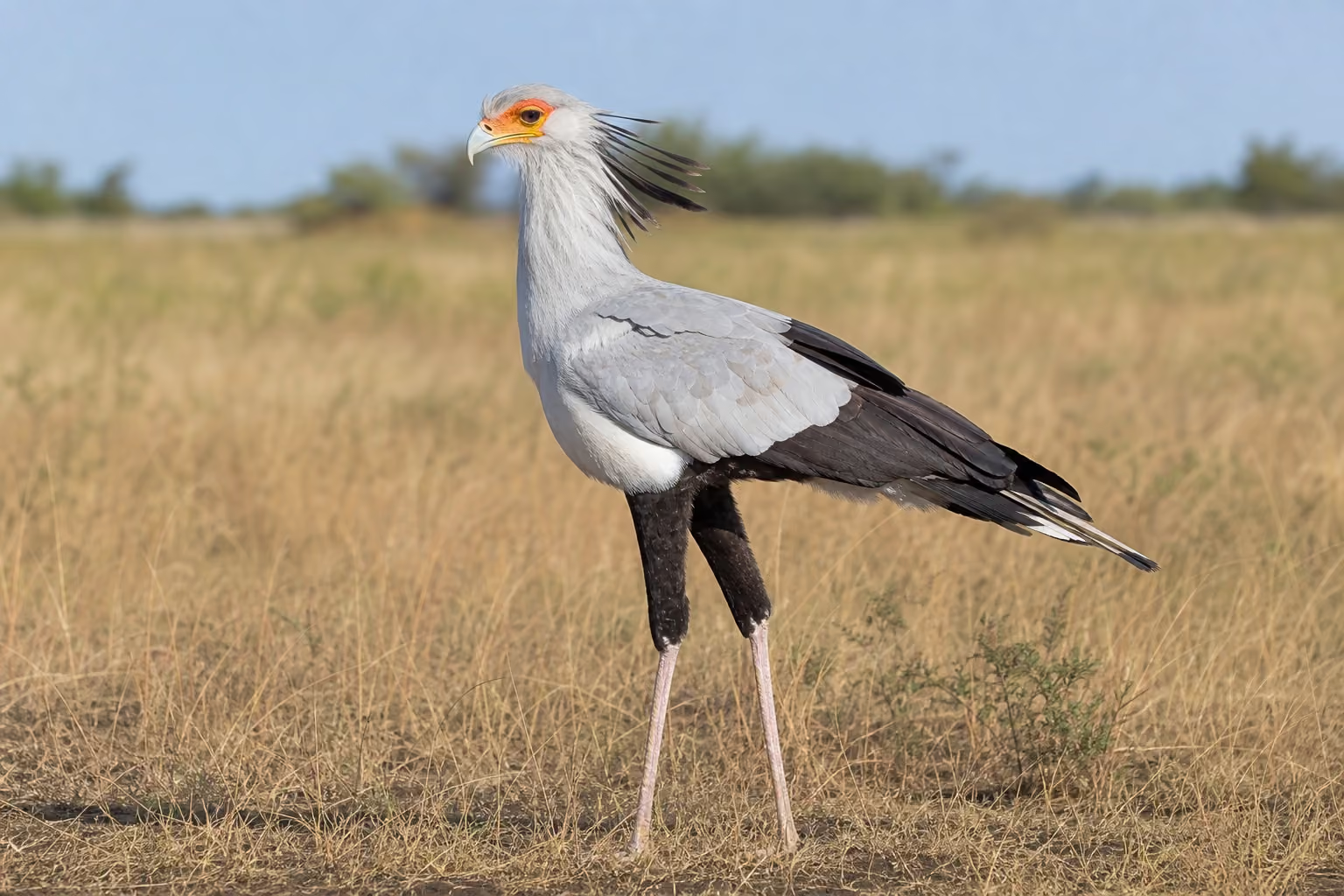
A long-legged, ground-dwelling African raptor that strides across the savanna hunting on foot rather than from the air. Famous for stamping snakes to death with powerful kicks, it carries a fan of black quill-like plumes on the back of its head that inspired its genus name Sagittarius, the archer.
Range

Habitat range map
Native range Occasional / Transient
AfrotropicalAfrotropicalAfrotropicalAfrotropical

Map: Ecoregions 2017 © RESOLVE (CC BY 4.0) · Natural Earth (PD)

Details

Habitat

Endemic to sub-Saharan Africa, ranging from Senegal to Somalia and south to the Western Cape of South Africa. It favors open savanna and grassland with short grass, avoiding both dense forest and desert.

Appearance

A large bird standing roughly 120 to 150 cm tall and weighing 2.3 to 4.5 kg, with an eagle-like body set on crane-like legs. The plumage is mostly grey with black flight feathers, the face is bare red-orange skin, and a crest of black plumes adorns the nape; the toes are unusually short.

Behavior

A diurnal terrestrial bird, it lives in pairs that defend territories of 20 to 500 square kilometres. It paces the grassland at 2.5 to 3 km/h, averaging about 120 steps a minute, and though it can fly it often runs from disturbance.

Feeding

Carnivorous, it eats insects and other arthropods, small mammals, lizards, and snakes. Hunting entirely on foot, it seizes small prey in its bill and dispatches larger prey such as snakes by stamping with repeated, forceful blows of its legs.

Reproduction

Pairs build a flat platform nest about a metre across in a thorny tree, laying one to three eggs at intervals of two to three days. Incubation lasts roughly 42 to 46 days, and the young fledge some 64 to 106 days after hatching. Pair bonds are thought to last for life.

Notes

Habitat loss, overgrazing, hunting, and collisions with power lines have driven a marked decline, and the species is now classed as endangered. It appears on the coats of arms of both South Africa and Sudan as a symbol of protection against threats.