077 Featured Specimen
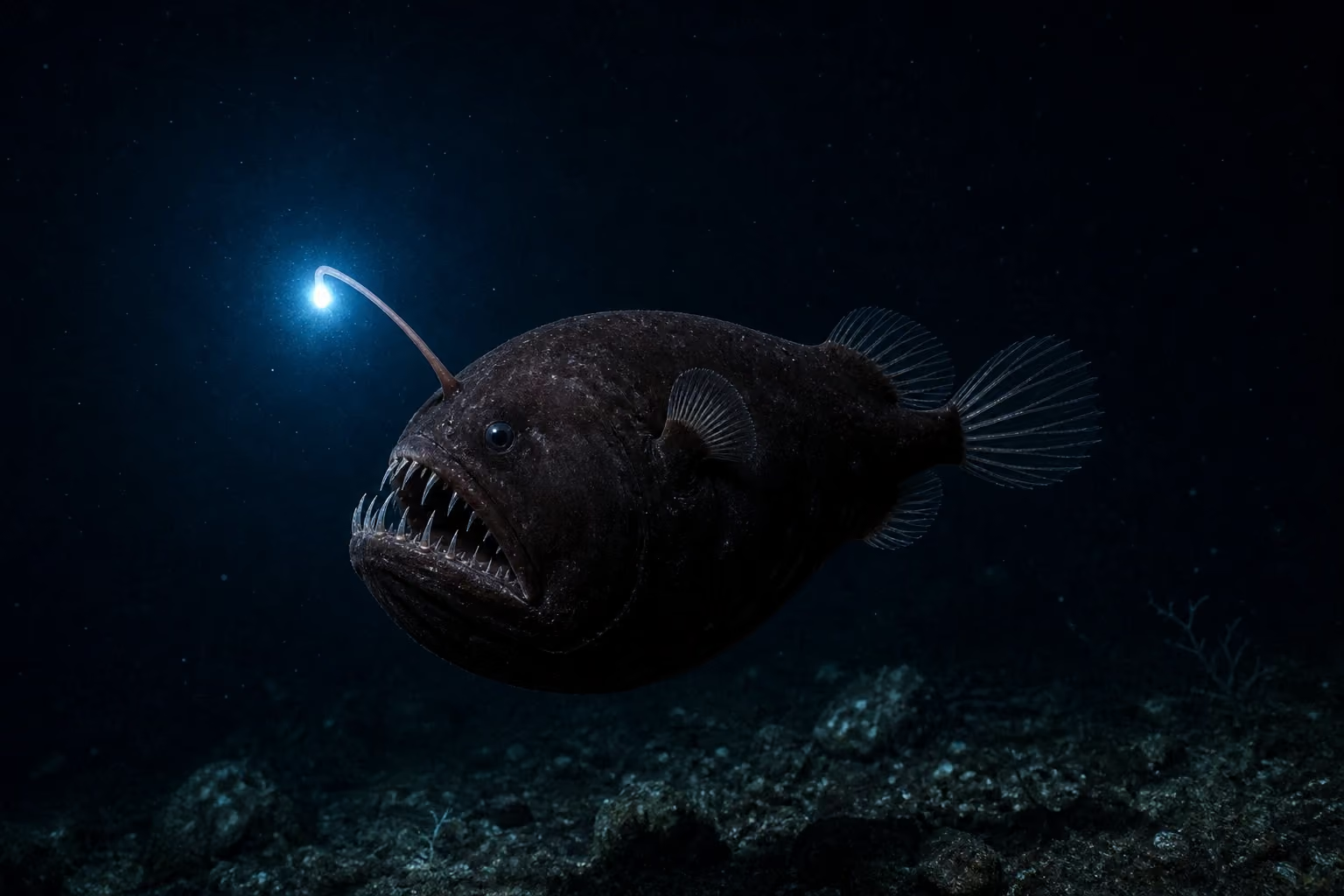
Humpback anglerfish

Details

Humpback anglerfish

Melanocetus johnsonii

Size
8–18 cm · 20–100 g
Diet
Carnivore
Activity
Nocturnal
Sociality
Solitary
Lifespan
Varies by species and environment

A deep-sea anglerfish of the family Melanocetidae that lives in perpetual darkness. The female lures prey with a glowing tip on a rod that rises from her head, then engulfs it whole in an enormous mouth. Males are dwarfs a fraction of her size and live freely on their own.
Range

Habitat range map
Native range Occasional / Transient
Pacific OceanPacific OceanPacific OceanAtlantic OceanAtlantic OceanAtlantic OceanAtlantic OceanAtlantic OceanIndian Ocean

Map: Ecoregions 2017 © RESOLVE (CC BY 4.0) · Natural Earth (PD)

Details

Habitat

It ranges widely through the temperate and tropical Atlantic, Pacific and Indian Oceans, the broadest distribution of any fish in its family. It haunts the lightless mesopelagic and bathypelagic zones, roughly 200 to 1,500 m down, with most records below 1,000 m.

Appearance

Females measure about 8 to 18 cm, with a short, almost globular body, a large head and a nearly vertical mouth lined with long fang-like teeth. The scaleless skin is velvety and dark brown to black, the eyes are small and set beneath the skin, and a bioluminescent lure rises from the snout. Males are tiny, just 1.5 to 2.8 cm.

Behavior

It lives alone, drifting almost motionless rather than swimming after food, lying in wait as an ambush predator. Its metabolism is exceptionally low, letting it conserve oxygen and endure the food-poor deep sea.

Feeding

A carnivore, it dangles and waves its glowing esca to draw fish and other prey within reach, then seizes them in its cavernous mouth. A highly distensible stomach lets it swallow prey larger than itself whole.

Reproduction

Unlike many anglerfish, males are non-parasitic and free-living. A male attaches only temporarily to a female to release sperm; fertilization is external, with the eggs shed into the open water.

Notes

The lure's glow comes from symbiotic luminescent bacteria. The species is not commercially fished and is listed as Least Concern by the IUCN, though individuals are occasionally taken as trawl bycatch.