516 Featured Specimen
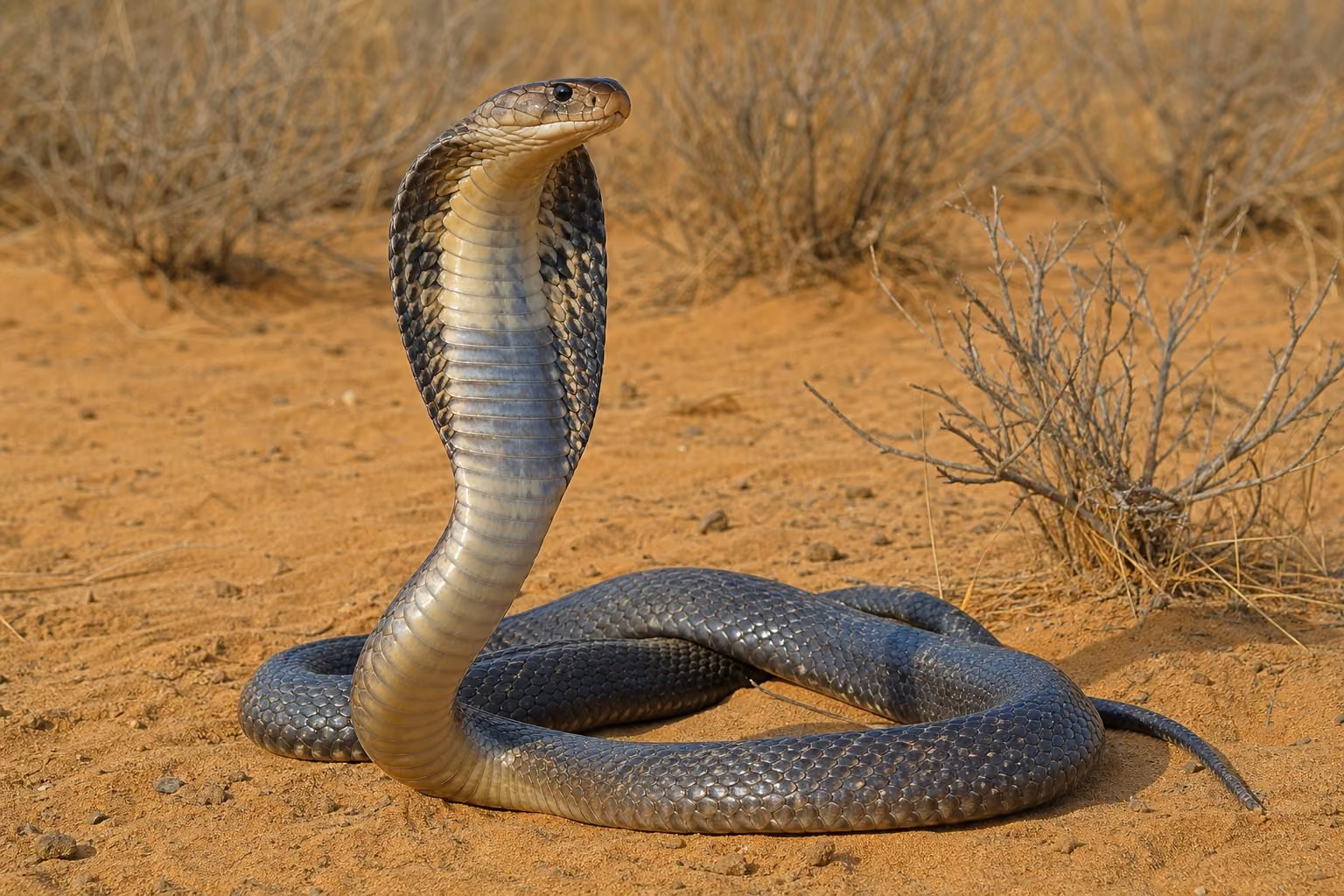
Egyptian cobra

Details

Egyptian cobra

Naja haje

Size
Total length 1–2.6 m
Diet
Carnivore
Activity
Crepuscular
Sociality
Solitary
Lifespan

One of Africa's largest venomous snakes, it rears up the front of its body and spreads a broad hood of cervical ribs when alarmed. Revered in ancient Egypt as the uraeus, the emblem of royal power, it is also tied to the legend of Cleopatra's death.
Range

Habitat range map
Native range Occasional / Transient
PalearcticPalearcticPalearcticPalearcticPalearcticPalearcticPalearcticPalearcticPalearcticPalearcticPalearcticPalearcticPalearcticPalearcticPalearcticPalearcticPalearcticPalearcticPalearcticPalearcticPalearcticPalearcticPalearcticPalearcticAfrotropicalAfrotropicalAfrotropicalAfrotropical

Map: Ecoregions 2017 © RESOLVE (CC BY 4.0) · Natural Earth (PD)

Details

Habitat

It ranges across North Africa north of the Sahara and southward through the West African savannas to the Congo Basin, Kenya, and Tanzania. It favours dry open country—steppe, savanna, semi-desert, and farmland—often near water, and readily enters villages in pursuit of rodents and poultry.

Appearance

It averages about 1.4 m but can approach 2.6 m in length. The head is large and flattened, and spreading the neck ribs forms a wide hood. The body is stout and cylindrical, and colour is highly variable: usually brownish, often with a tear-drop mark below the eye, while Moroccan snakes can be almost wholly black, and the underside ranges from cream to dark brown.

Behavior

Terrestrial and solitary, it is most active around dawn and dusk and keeps a permanent base in a burrow, termite mound, or rock crevice. When threatened it raises the forebody, spreads its hood, and hisses; if pressed further it may feign death.

Feeding

A carnivore, it forages actively over the ground, preying mainly on toads but also taking small mammals, birds, eggs, lizards, and other snakes, and at times raiding dwellings for food.

Reproduction

It is oviparous, the female laying a clutch of eggs. Though a large and highly venomous cobra, the finer details of its breeding biology remain poorly documented.

Notes

It carries copious, potent neurotoxins and cytotoxins and is dangerous if it bites, yet the IUCN lists it as Least Concern. In ancient Egypt it was seen as the goddess Wadjet and worn as the uraeus on pharaohs' crowns, a symbol of sovereignty. Cleopatra is said to have died by its bite, though the snake's size and slow-acting venom make modern scholars doubt the tale.