103 Featured Specimen
Arctic fox

Details

Arctic fox

Vulpes lagopus

Size
46–68 cm · 3–9.4 kg
Diet
Omnivore
Activity
Cathemeral
Sociality
Pair
Lifespan
10-20 years

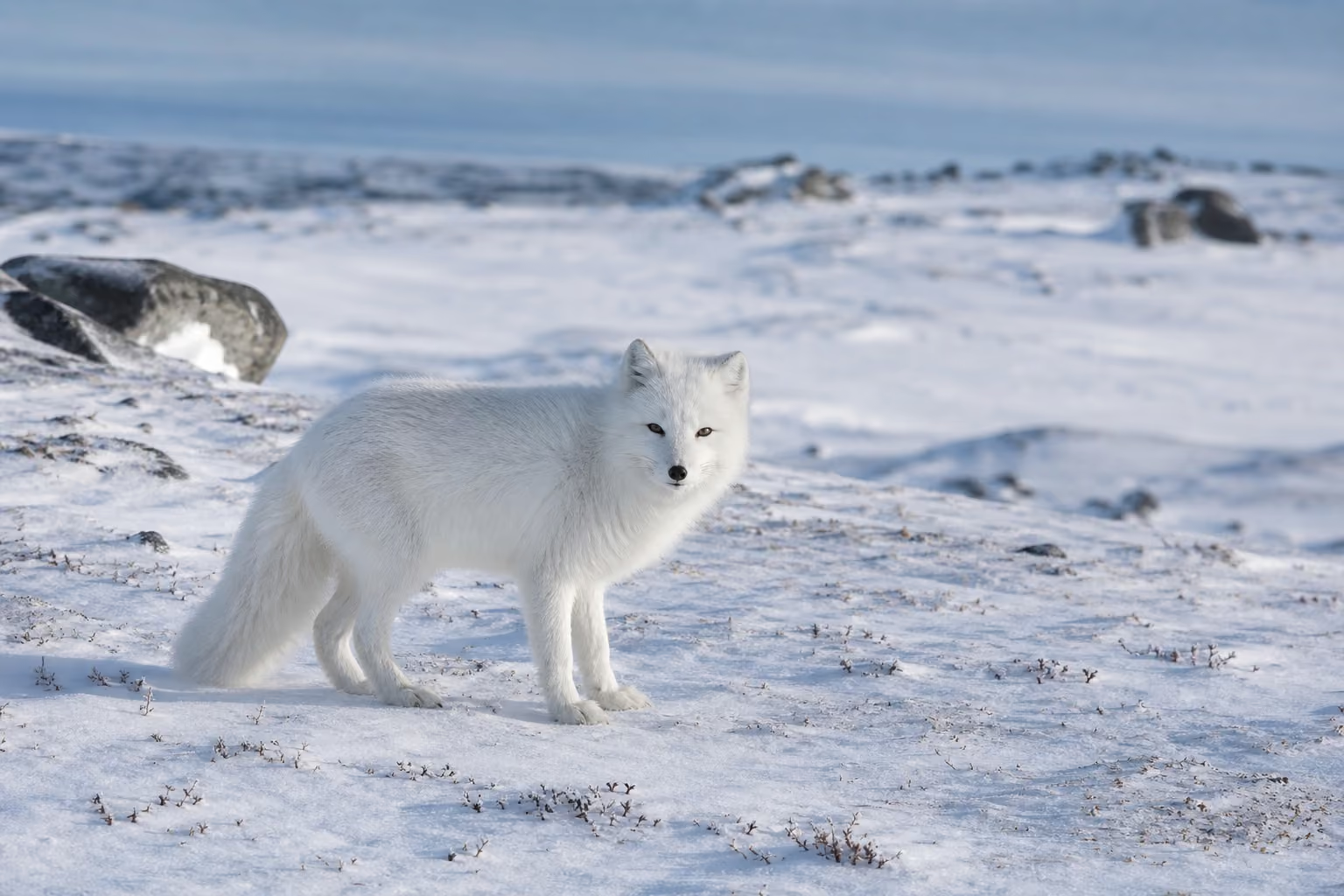
The Arctic fox is a small fox of the polar tundra, wrapped in fur said to give the finest insulation of any mammal. It transforms with the seasons, turning snow-white in winter and a rocky brown-grey in summer.
Range

Habitat range map
Native range Occasional / Transient
PalearcticPalearcticPalearcticPalearcticPalearcticPalearcticPalearcticPalearcticPalearcticPalearcticPalearcticPalearcticPalearcticPalearcticPalearcticPalearcticPalearcticPalearcticPalearcticPalearcticPalearcticPalearcticPalearcticPalearcticNearcticNearcticNearcticNearcticNearcticNearcticNearcticNearcticNearcticNearcticNearcticNearcticNearcticNearcticNearcticNearcticNearcticNearcticNearcticNearcticNearcticNearcticNearcticNearcticNearcticNearcticNearcticNearcticNearcticNearcticNearcticNearcticNearcticNearcticNearcticNearcticNearcticNearcticNearcticNearcticNearctic

Map: Ecoregions 2017 © RESOLVE (CC BY 4.0) · Natural Earth (PD)

Details

Habitat

It ranges across the Arctic tundra of the Nearctic and Palearctic, from Greenland, Iceland, Svalbard and Russia to Alaska and Canada. It occupies coastal flats, high ground up to about 3,000 m, and even ventures onto the winter pack ice.

Appearance

Head-and-body length runs about 46-68 cm and weight 3-9.4 kg, with the bushy tail making up roughly a third of its length. A short muzzle, short legs, small thick ears and a rounded body limit heat loss, while underfur forms around 70 percent of its coat. Most foxes are the white morph, though a slate-blue morph stays dark year-round.

Behavior

Active throughout the year without hibernating, it forages by day and night alike. Pairs are typically monogamous, and both parents share the rearing of pups. Dens dug into dry, raised ground such as eskers form sprawling tunnel systems that may serve many generations of foxes.

Feeding

Its mainstay is the lemming, whose 3-5 year boom-and-bust cycles drive its fortunes; in good years a family may eat dozens a day. It also takes birds, eggs, fish and seal pups, scavenges carcasses left by polar bears and other large predators, eats berries and seaweed, and caches goose eggs for the following spring.

Reproduction

Mating occurs in April and May, with a gestation of about 52 days and births in late spring or early summer. Litter size swings with food: inland white foxes may bear 6-18 pups when lemmings peak yet skip breeding in lean years. Newborns are blind and deaf for about two weeks and are weaned by roughly seven weeks.

Notes

Globally widespread and numerous, the species nonetheless includes a critically threatened relict population on the Scandinavian mainland, where only around 120 adults remain. Warming that thins snow cover leaves the white coat conspicuous, and competition with the larger red fox adds further pressure.