020 Featured Specimen
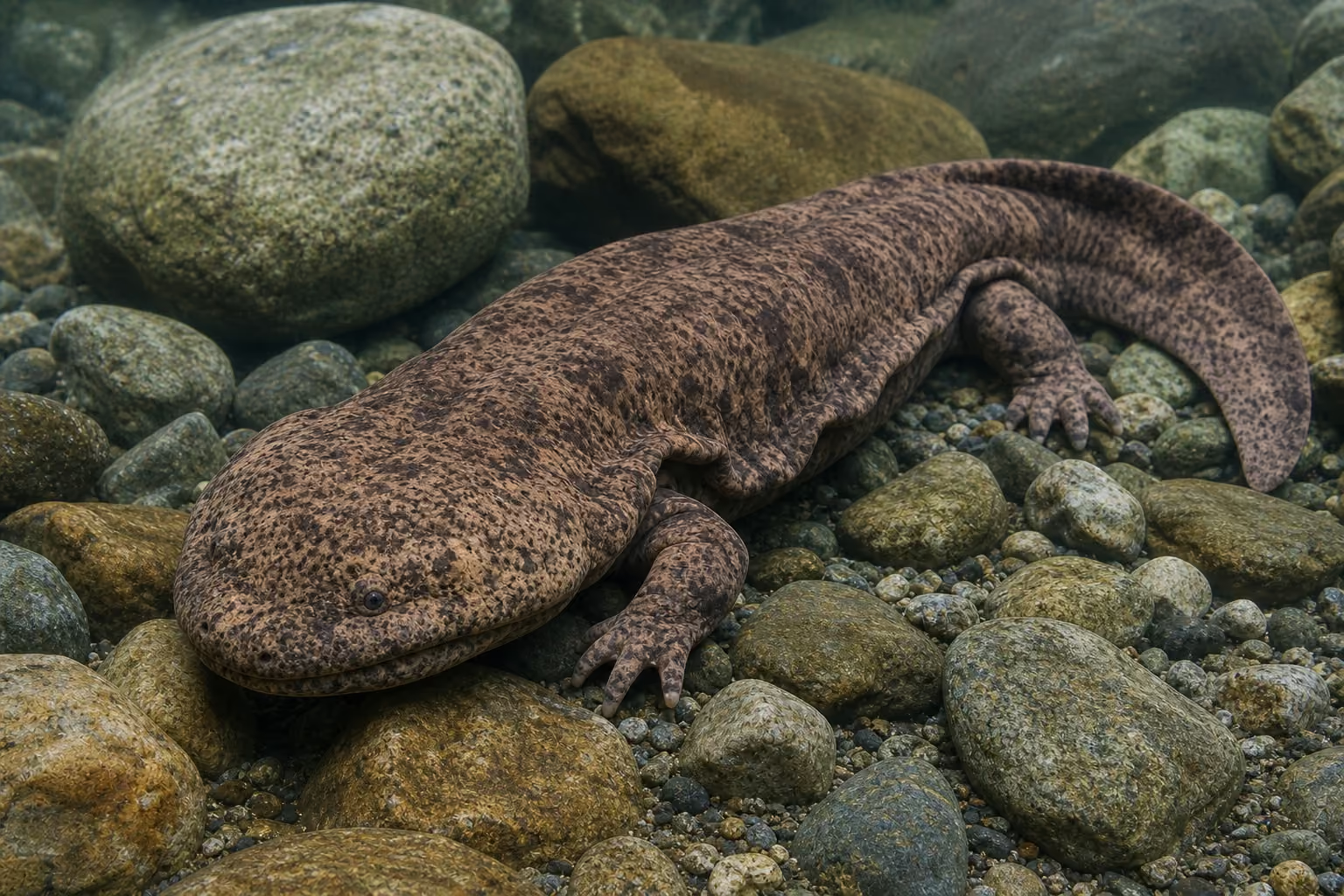
Japanese giant salamander

Details

Japanese giant salamander

Andrias japonicus

Size
0.5–1.5 m · 5–25 kg
Diet
Carnivore
Activity
Nocturnal
Sociality
Solitary
Lifespan
50 years or more

One of the world's largest amphibians, reaching up to 1.5 m in length in the clear mountain streams of Japan. Fully aquatic and active by night, this living fossil is endemic to Japan and is thought to have inspired the legendary kappa.
Range

Habitat range map
Native range Occasional / Transient

Map: Ecoregions 2017 © RESOLVE (CC BY 4.0) · Natural Earth (PD)

Details

Habitat

It lives in cold, clear, fast-flowing mountain streams of southwestern Japan, on Honshu west of Gifu, Shikoku, and northern Kyushu. Entirely aquatic, it needs oxygen-rich running water and cannot survive in still pools.

Appearance

At 50 to 150 cm long and up to 25 kg, it is the third-largest salamander on Earth. Mottled brown and black skin, studded with small warts, camouflages it against the streambed, and broad folds of loose skin along the body increase its surface for absorbing oxygen. Its eyes are tiny and its sight poor.

Behavior

Nocturnal, it shelters by day under rocks or in burrows dug into the bank and emerges to forage after dark. Largely solitary, it breathes by raising only its head to the surface, and when threatened it secretes a strong-smelling, milky fluid.

Feeding

A carnivore, it takes crabs and other crustaceans, fish, worms, frogs, and even snakes or small mammals. Rather than relying on vision, it senses prey through the lateral-line organs in its skin and engulfs it with a sudden gulp of its wide mouth; its slow metabolism lets it fast for weeks.

Reproduction

Breeding runs from late August into September. A large male holds a den upstream where one or more females lay strings of roughly 400 to 500 eggs. The male then guards the clutch, fanning oxygenated water over it with his tail and removing dead eggs; the larvae hatch after about 50 days.

Notes

Endemic to Japan and protected as a Special Natural Monument since 1952, it is threatened by river engineering, dams, and weirs that fragment its habitat and block migration. Hybridization with introduced Chinese giant salamanders is a grave concern, with most animals sampled in Kyoto's Kamo River found to be hybrids. Captive individuals have lived more than 50 years.