052 Featured Specimen
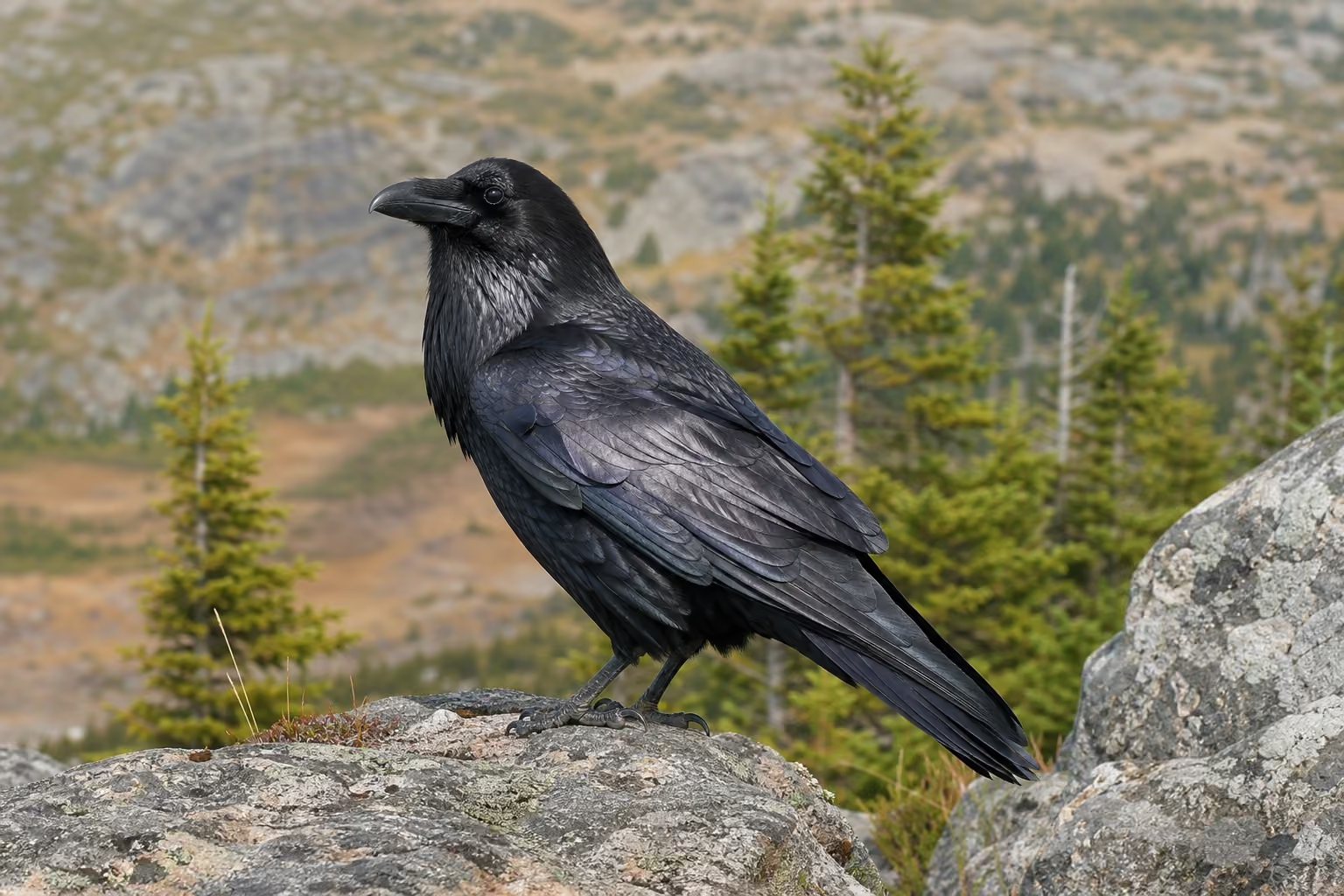
Common raven

Details

Common raven

Corvus corax

Size
Wingspan 1–1.5 m · 0.7–2 kg
Diet
Omnivore
Activity
Diurnal
Sociality
Pair
Lifespan
Several years to decades

A glossy all-black corvid and one of the largest perching birds in the world. Famed for exceptional intelligence, it can plan ahead and reason about cause and effect at a level rivalling great apes.
Range

Habitat range map
Native range Occasional / Transient
PalearcticPalearcticPalearcticPalearcticPalearcticPalearcticPalearcticPalearcticPalearcticPalearcticPalearcticPalearcticPalearcticPalearcticPalearcticPalearcticPalearcticPalearcticPalearcticPalearcticPalearcticPalearcticPalearcticPalearcticNearcticNearcticNearcticNearcticNearcticNearcticNearcticNearcticNearcticNearcticNearcticNearcticNearcticNearcticNearcticNearcticNearcticNearcticNearcticNearcticNearcticNearcticNearcticNearcticNearcticNearcticNearcticNearcticNearcticNearcticNearcticNearcticNearcticNearcticNearcticNearcticNearcticNearcticNearcticNearcticNearctic

Map: Ecoregions 2017 © RESOLVE (CC BY 4.0) · Natural Earth (PD)

Details

Habitat

It has the largest range of any member of its genus, spanning the Nearctic and Palearctic across the Northern Hemisphere. Highly adaptable, it occupies forests, mountains, deserts and coasts, and has been recorded above 5,000 m in Tibet. In Japan it appears as a winter visitor in northern and eastern Hokkaido.

Appearance

One of the heaviest passerines, with a wingspan of about 100-150 cm and a weight of 700-2,000 g. The plumage is entirely black, gleaming with blue or purple iridescence in sunlight. Distinctive features include a heavy, curved bill, pointed throat hackles and a long, wedge-shaped tail.

Behavior

Active by day, ravens travel chiefly in mated pairs that bond for life and defend a territory. They give a deep, resonant prruk-prruk call within a wide vocabulary and even mimic sounds, and are notably playful, sliding down snowbanks seemingly for fun.

Feeding

An omnivorous, highly opportunistic forager, it takes carrion, insects, fruit, grain, small animals, eggs and nestlings, and human food waste. It calls others to a rich food find and caches surplus food, hiding it out of sight of rival ravens.

Reproduction

Monogamous pairs build a large stick nest on a cliff ledge or in a tree. The female lays four to six pale bluish-green, blotched eggs, usually from late winter to spring, and incubates them for 18-21 days. Young fledge at 35-49 days and stay with their parents for about six more months.

Notes

Listed as Least Concern, the raven has increased in some regions thanks to human food sources. Wild birds typically live 10-15 years. Deeply woven into Northern Hemisphere myth and culture, it is the national bird of Bhutan and is kept as a guardian at the Tower of London.