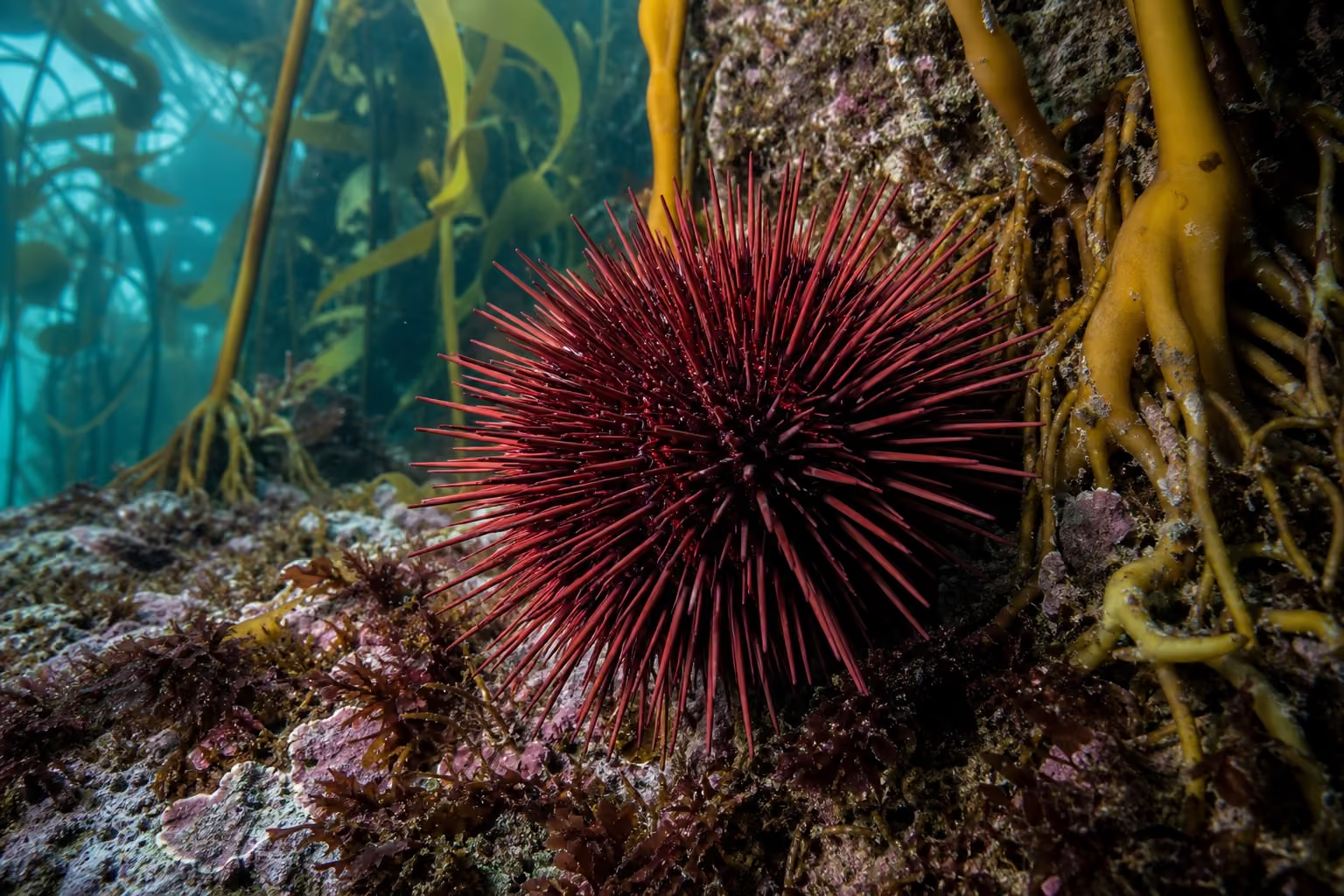
Red sea urchin

Details

Red sea urchin

Mesocentrotus franciscanus

Size
8–18 cm · 0.2–1 kg
Diet
Herbivore
Activity
Nocturnal
Sociality
Loose group
Lifespan
30–100 years

The red sea urchin is a large rocky-coast urchin of the North Pacific. Its long red spines protect a grazing body that can shape kelp communities.

View in catalog
Key facts

  • Red sea urchin (Mesocentrotus franciscanus) is a herbivore animal classified as Invertebrate · Echinoida · Strongylocentrotidae.
  • Primary habitats are coast · coral reef · open ocean, with a range across Pacific Ocean.
  • Activity is nocturnal, sociality is loose group, and conservation status is LC (Least Concern).
  • The red sea urchin is a large rocky-coast urchin of the North Pacific.
  • It lives on cool Pacific rocky reefs, kelp forests, and subtidal bottoms.
  • Typical lifespan: 30–100 years

Range

Habitat range map
Native rangeOccasional / Transient
Pacific OceanPacific OceanPacific Ocean

Map: Ecoregions 2017 © RESOLVE (CC BY 4.0) · Natural Earth (PD)

Details

Habitat

It lives on cool Pacific rocky reefs, kelp forests, and subtidal bottoms. Crevices and seaweed-rich areas often hold dense groups.

Appearance

Test diameter 8-18 cm; weight 200 g-1 kg. The hard round test is covered with long red to dark red spines. Five strong teeth on the underside scrape algae.

Behavior

Nocturnal and loosely gregarious, it usually shelters by day. At night it moves slowly with tube feet and spines.

Feeding

A herbivore, it grazes kelp and attached algae. Where standing kelp is scarce, drifting pieces of seaweed become important food.

Reproduction

Adults release eggs and sperm into the water. Fertilized eggs develop into planktonic larvae that later settle onto rocky bottom.

Notes

It is listed as Least Concern. Local densities can swing sharply with predator abundance, kelp supply, and ocean conditions.