518 Featured Specimen
Slow worm

Details

Slow worm

Anguis fragilis

Size
Total length 40–57.5 cm
Diet
Carnivore
Activity
Crepuscular
Sociality
Solitary
Lifespan

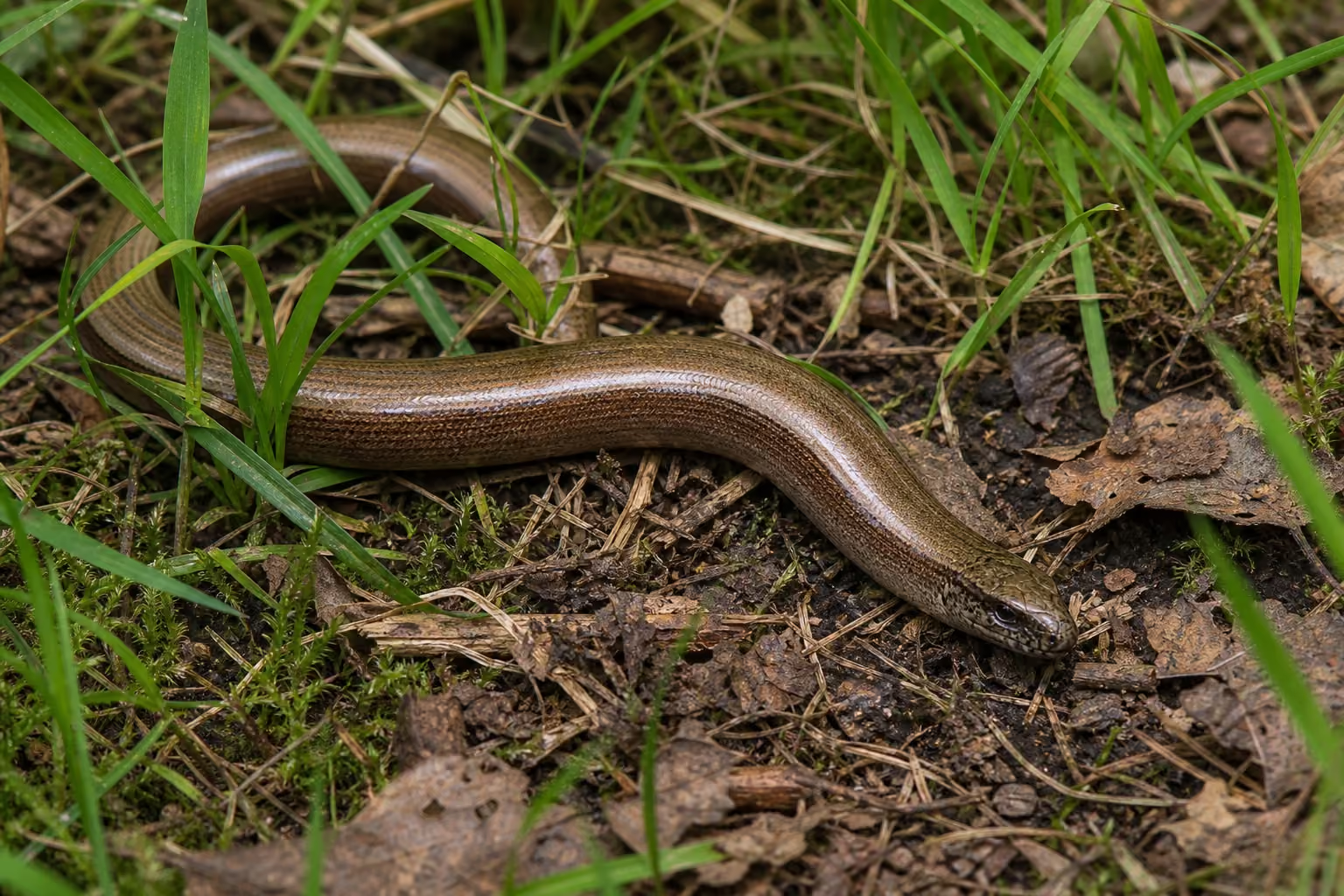
Despite its snake-like, legless body, the slow worm is a lizard, not a snake. Movable eyelids and the ability to shed and regrow its tail give it away as a glossy, burrowing reptile rather than a serpent.
Range

Habitat range map
Native range Occasional / Transient
PalearcticPalearcticPalearcticPalearcticPalearcticPalearcticPalearcticPalearcticPalearcticPalearcticPalearcticPalearcticPalearcticPalearcticPalearcticPalearcticPalearcticPalearcticPalearcticPalearcticPalearcticPalearcticPalearcticPalearctic

Map: Ecoregions 2017 © RESOLVE (CC BY 4.0) · Natural Earth (PD)

Details

Habitat

Native across western and northern Europe and the western Balkans, and common in Britain. It favours damp grassland, heath, woodland edges, gardens and allotments, sheltering beneath logs, stones and leaf litter.

Appearance

Adults reach about 50 cm, with a maximum recorded length of 57.5 cm. The smooth, non-overlapping scales give a polished sheen; females show a dark spinal stripe and dark flanks, while males are more uniformly grey-brown and may carry blue spots.

Behavior

A semi-fossorial, solitary reptile, it is most active in the twilight hours and after rain, otherwise staying hidden underground or under cover. It hibernates through the cold months and is remarkably long-lived, reaching around 30 years in the wild and over 50 in captivity.

Feeding

Carnivorous, it preys mainly on slow, soft-bodied invertebrates such as slugs, snails and earthworms, flicking its tongue to smell out prey before seizing it.

Reproduction

The slow worm is ovoviviparous, retaining its eggs internally and giving birth to live young. After a gestation of 11 to 14 weeks, females produce eight to twelve young from mid-July to late August, each newborn only 7 to 10 cm long.

Notes

In the UK it is legally protected under the Wildlife and Countryside Act 1981, making it illegal to kill or injure deliberately. Cats, badgers and birds are its main predators, and habitat loss is a threat; gardeners value it for eating pest slugs.