044 Featured Specimen
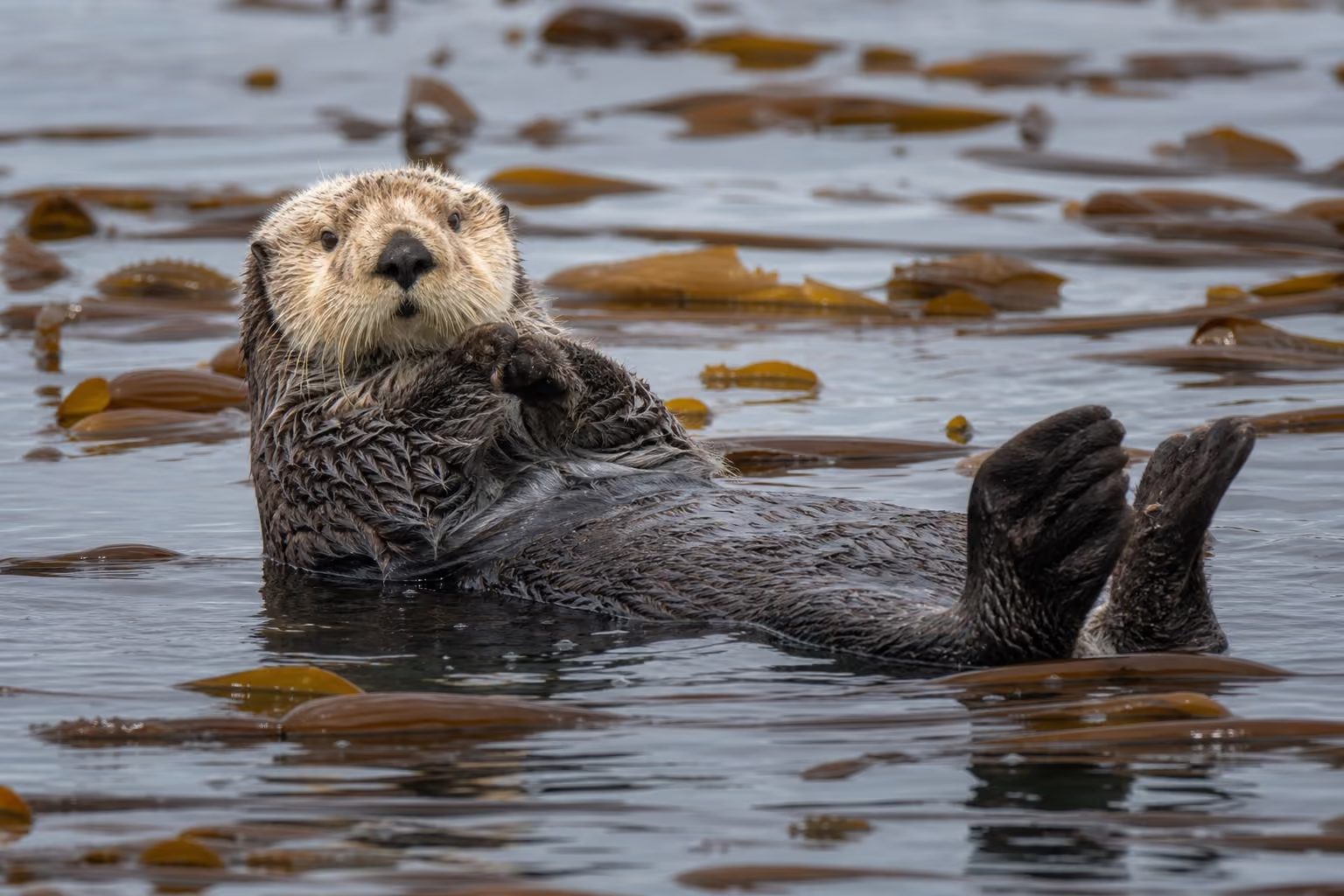
Sea otter

Details

Sea otter

Enhydra lutris

Size
1–1.5 m · 14–45 kg
Diet
Carnivore
Activity
Diurnal
Sociality
Loose group
Lifespan
10-20 years

The largest member of the weasel family and a fully marine mammal of North Pacific coasts, famous for floating on its back to feed on shellfish and sea urchins. It wears the densest fur in the animal kingdom and is one of the few mammals known to use tools, cracking prey against a stone balanced on its chest.
Range

Habitat range map
Native range Occasional / Transient
Pacific OceanPacific OceanPacific OceanPalearcticPalearcticPalearcticPalearcticPalearcticPalearcticPalearcticPalearcticPalearcticPalearcticPalearcticPalearcticPalearcticPalearcticPalearcticPalearcticPalearcticPalearcticPalearcticPalearcticPalearcticPalearcticPalearcticPalearcticNearcticNearcticNearcticNearcticNearcticNearcticNearcticNearcticNearcticNearcticNearcticNearcticNearcticNearcticNearcticNearcticNearcticNearcticNearcticNearcticNearcticNearcticNearcticNearcticNearcticNearcticNearcticNearcticNearcticNearcticNearcticNearcticNearcticNearcticNearcticNearcticNearcticNearcticNearcticNearcticNearctic

Map: Ecoregions 2017 © RESOLVE (CC BY 4.0) · Natural Earth (PD)

Details

Habitat

It lives in shallow coastal waters of the North Pacific, favoring rocky shores and kelp forests within about a kilometer of land. Once continuous from Japan to Baja California, its range is now fragmented, with relict populations in places such as Russia, Alaska, California, and eastern Hokkaido.

Appearance

Adults run about 100 to 150 cm long and weigh 14 to 45 kg, with males the larger sex. The coat is deep reddish-brown to nearly black, paling to grizzled gray on the head and throat. Its defining feature is fur of roughly 160,000 hairs per square centimeter, the densest known, which traps air for insulation; the hind feet are webbed and the tail flattened.

Behavior

Active by day, it forages in several bouts and rests in single-sex groups called rafts, often anchoring itself by wrapping in kelp so it does not drift. Maintaining the fur's waterproofing demands constant, meticulous grooming, which occupies much of its time.

Feeding

A carnivore, it preys on a wide array of invertebrates, chiefly sea urchins, mollusks, and crustaceans. To fuel its high metabolism it must eat 25 to 38 percent of its body weight each day, and it famously uses a rock as an anvil or hammer to break open hard shells.

Reproduction

Gestation varies widely because of delayed implantation. A female usually bears a single pup, occasionally twins of which typically only one survives. The mother nurses and tends her pup on the water's surface, often resting it on her belly, and cares for it from several months up to nearly a year.

Notes

The fur trade of the 18th to early 20th centuries killed around a million sea otters, cutting the species to perhaps 1,000 to 2,000 animals before a 1911 treaty ended hunting. Recovering but still threatened, it is highly vulnerable to oil spills, which destroy the fur's insulation, and to entanglement in fishing gear. As a keystone species it sustains kelp forests by keeping sea urchins in check.