Loggerhead sea turtle

Details

Loggerhead sea turtle

Caretta caretta

Size
Total length 0.7–1.1 m · 70–200 kg
Diet
Omnivore
Activity
Diurnal
Sociality
Solitary
Lifespan

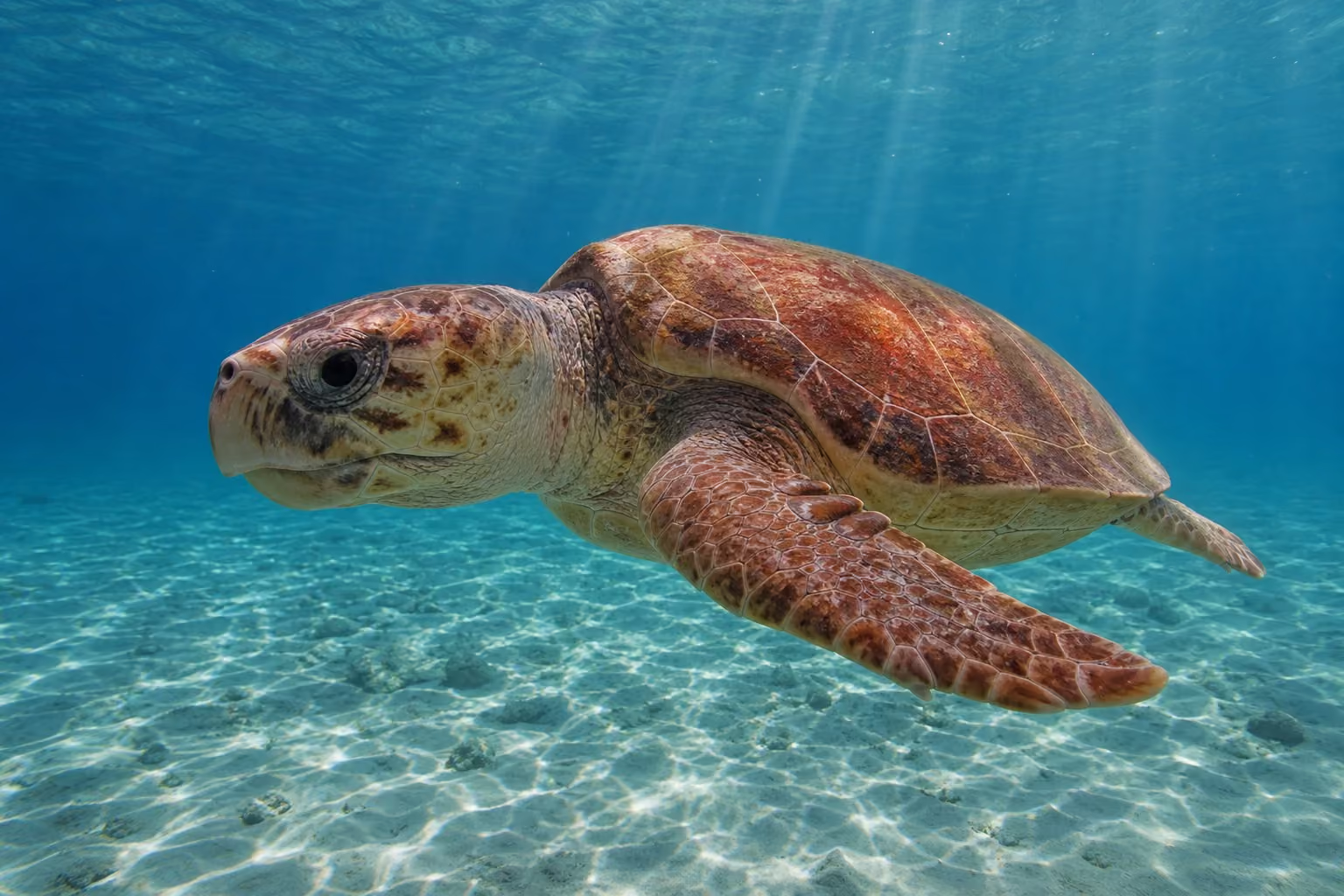
A large sea turtle named for its broad, blocky head and exceptionally powerful jaws, which crush hard-shelled prey other turtles cannot. Its reddish-brown, heart-shaped carapace is unmistakable. It ranges across the Atlantic, Pacific, and Indian Oceans and into the Mediterranean.

View in catalog
Key facts

  • Loggerhead sea turtle (Caretta caretta) is an omnivore animal classified as Reptile · Testudines · Cheloniidae.
  • Primary habitats are open ocean · coast, with a range across Atlantic Ocean · Pacific Ocean · Indian Ocean.
  • Activity is diurnal, sociality is solitary, and conservation status is VU (Vulnerable).
  • A large sea turtle named for its broad, blocky head and exceptionally powerful jaws, which crush hard-shelled prey other turtles cannot.
  • It lives in both the open ocean and shallow coastal waters of temperate and subtropical seas.

Range

Habitat range map
Native rangeOccasional / Transient
Pacific OceanPacific OceanPacific OceanAtlantic OceanAtlantic OceanAtlantic OceanAtlantic OceanAtlantic OceanIndian Ocean

Map: Ecoregions 2017 © RESOLVE (CC BY 4.0) · Natural Earth (PD)

Details

Habitat

It lives in both the open ocean and shallow coastal waters of temperate and subtropical seas. Hatchlings drift in floating mats of Sargassum weed far offshore, while major nesting beaches lie in Florida, Oman, Greece, and Japan.

Appearance

The carapace measures roughly 70 to 105 cm, and adults weigh from 70 to 200 kg. The shell is reddish-brown and broadest toward the front; the skin and underside shade from yellow to brown. Its outsized head and thick, muscular jaws are the defining feature.

Behavior

It is active by day and lives a solitary life, spending much of its time submerged on long dives. Females may behave aggressively toward one another over feeding grounds, and individuals migrate across vast stretches of ocean as they mature.

Feeding

An omnivore that forages along the seabed, it feeds chiefly on invertebrates such as whelks, conchs, and crabs, and also takes jellyfish, fish eggs, and urchins. Its large, powerful jaws let it crush hard shells, giving it the widest known prey range of any sea turtle.

Reproduction

Females come ashore to dig a nest with their hind flippers, laying about 70 to 150 eggs and repeating this several times in a season. Eggs incubate in the warm sand for roughly 50 to 80 days, with warmer temperatures producing more females. There is no parental care; hatchlings emerge at night and head for the sea on their own.

Notes

The IUCN lists the loggerhead as Vulnerable, and it is protected under CITES Appendix I. Key threats include bycatch in longlines and gillnets, coastal development that destroys nesting beaches, ocean plastic, and nest predation by raccoons and other animals.