Bactrian camel

Details

Bactrian camel

Camelus bactrianus

Size
2.2–3.5 m · 300–690 kg
Diet
Herbivore
Activity
Diurnal
Sociality
Herd
Lifespan
10-20 years

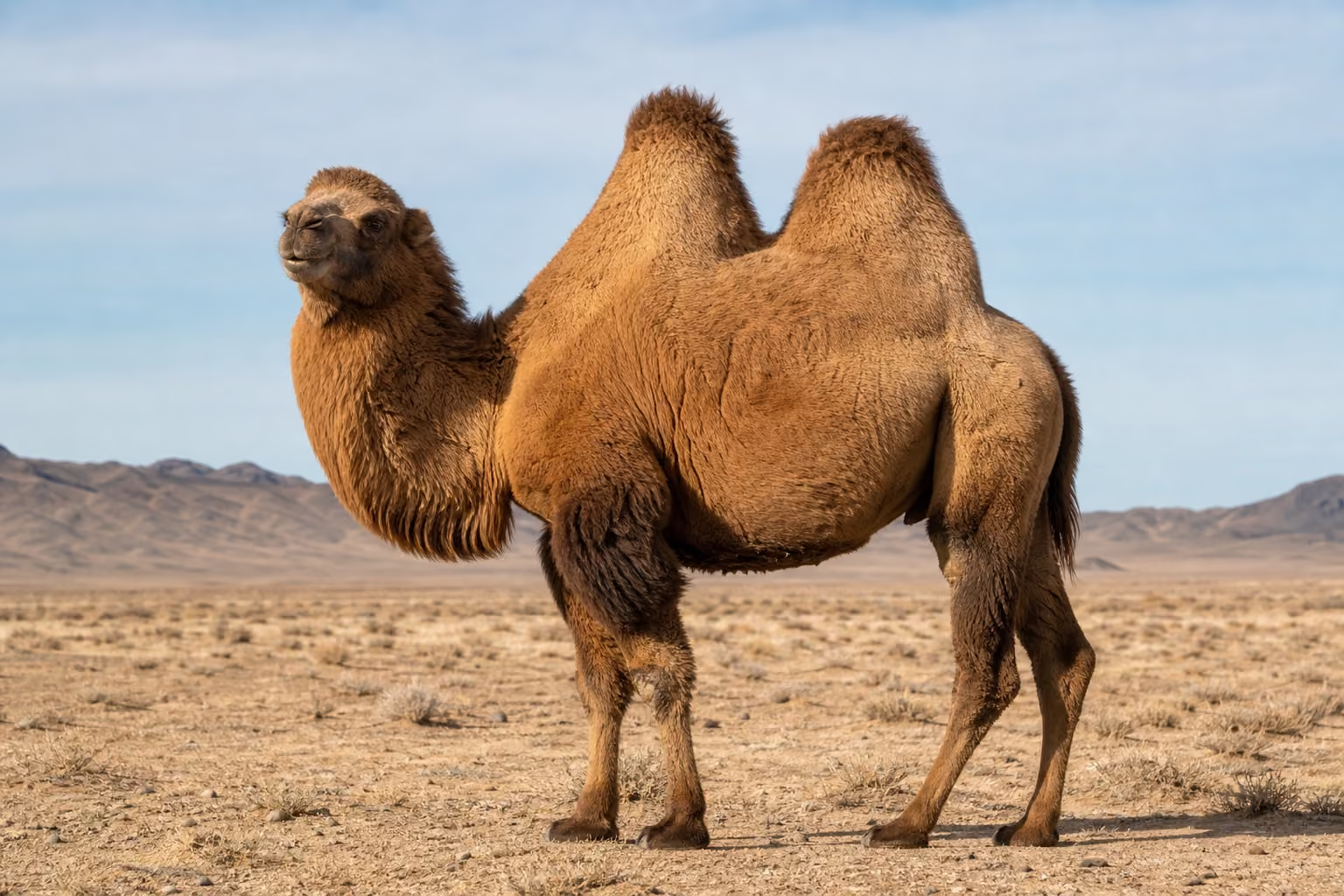
The Bactrian camel is the largest living camel, a two-humped giant of the Central Asian deserts and steppes. Fat stored in its twin humps and a thick woolly coat let it endure extremes from −30°C to 50°C. Domesticated around 2500 BCE, it has long been the workhorse of the Silk Road caravans.

View in catalog
Key facts

  • Bactrian camel (Camelus bactrianus) is a herbivore animal classified as Mammal · Cetartiodactyla · Camelidae.
  • Primary habitats are desert · grassland, with a range across Palearctic.
  • Activity is diurnal, sociality is herd, and conservation status is LC (Least Concern).
  • The Bactrian camel is the largest living camel, a two-humped giant of the Central Asian deserts and steppes.
  • It ranges across the arid Palearctic, centred on the Gobi Desert, moving between rocky mountain massifs, open steppe, stony plains, and sand dunes.
  • Typical lifespan: 10-20 years

Range

Habitat range map
Native rangeOccasional / Transient
PalearcticPalearcticPalearcticPalearcticPalearcticPalearcticPalearcticPalearcticPalearcticPalearcticPalearcticPalearcticPalearcticPalearcticPalearcticPalearcticPalearcticPalearcticPalearcticPalearcticPalearcticPalearcticPalearcticPalearctic

Map: Ecoregions 2017 © RESOLVE (CC BY 4.0) · Natural Earth (PD)

Details

Habitat

It ranges across the arid Palearctic, centred on the Gobi Desert, moving between rocky mountain massifs, open steppe, stony plains, and sand dunes.

Appearance

A heavy animal roughly 220–350 cm long and 300–690 kg, it carries two fat-filled humps on its back. The shaggy coat shades from dark brown to sandy beige, with neck and shoulder hairs reaching up to 25 cm. Long eyelashes, sealable nostrils, and two broad spreading toes are all adaptations to wind-driven sand.

Behavior

It is active by day, foraging in daylight and resting in the open at night. Animals live in small family herds of one bull with several females and their young.

Feeding

A herbivore, it chews the cud and copes with dry, thorny, and bitter vegetation that other grazers refuse. When water is available it drinks great quantities at once to carry it through long dry spells.

Reproduction

Gestation lasts about 13 months, producing a single calf (occasionally twins). The calf nurses for roughly a year and a half, and young reach sexual maturity at three to five years.

Notes

The domestic form has served people for millennia, providing wool, milk, and transport across harsh terrain. Genetic studies show domestic and wild camels (Camelus ferus) split around 1.1 million years ago as separate lineages; that wild relative survives only as a tiny, severely threatened population.